Dinner with the Speaker at 5:30 p.m. is at Aung MayLika 1050 Contra Costa Blvd, Concord, CA 94423
Everyone is welcome to attend and meet our speaker – email Eileen Jackson before Jan 10th at eileen.jackson@att.com to reserve a seat.

Dinner with the Speaker at 5:30 p.m. is at Aung MayLika 1050 Contra Costa Blvd, Concord, CA 94423
Everyone is welcome to attend and meet our speaker – email Eileen Jackson before Jan 10th at eileen.jackson@att.com to reserve a seat.
“I was born August 2, 1946 in the city of Berkeley, California and have remained a resident ever since. I met my partner, John Leathers in 1975 and we began growing orchids after we purchased a home with a built on solarium. In 1979 we bought our present home and built a 15′ x 25′ standalone glass greenhouse.
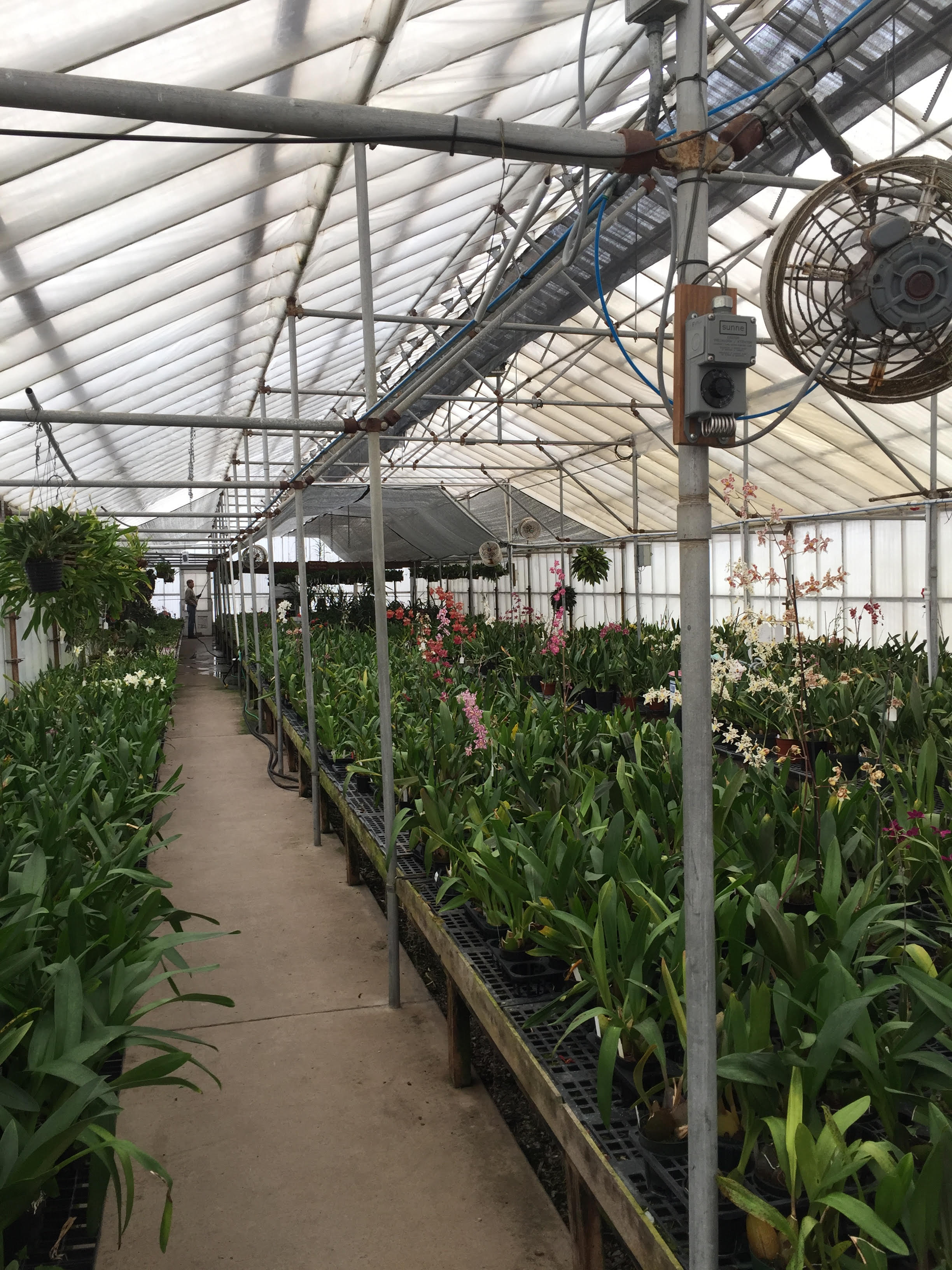
Greenhouse at Pacifica
As our avocation expanded we rented additional greenhouse space in Daly City sharing it with other orchid friends. For the 15 or so years we’ve rented space in Pacifica, California. We currently grow in a 3000 sq. ft greenhouse and hybridize orchids. John and I do our own lab work, pod to blooming plant; have a well equipped lab in our home.
We both had careers at UC Berkeley. John retired as manager of Printing Services, an operation that printed for all nine campuses and I retired as manager for facilities and equipment of the Marvell Microfabrication Laboratory, a shared semiconductor research facility meeting needs for more than 400 researchers.
We specialize in cool growing Andean orchid species, John in the genus Dracula and Masdevallia and I in Odontoglossums.Our goal is to improve plants in these genera, share them with others and do our best to maintain the interest in hobby orchid growing given, as with many hobbies, a “greying” of participants. We now see our collection and work mostly as a preservation effort.
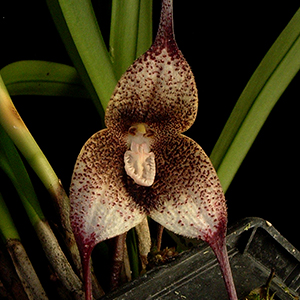
In addition to orchids I play classical piano. We are both avid art collectors – yet another of our bottomless money pits and John is the editor of The International Odontoglossum Alliance newsletter published in both Spanish and English with a readership of more than 180 subscribers.
My talk begins with the discovery of nature at the beginning of the 19th Century, an age of invention and the tremendous social changes which that century begot. The Victorian orchid craze was one result. The momentum and enthusiasm for orchid raising went on for most of the next 100 years. We have entered an age where hobbies are graying, competing with social media for time. Property values are high, building codes interfere with construction of greenhouses and big-box stores sell orchid plants below cost as “price leader” thus destroying small businesses. Inept interference by the Royal Horticultural Society and a failure of leadership by the American Orchid Society have created an embargo on how plants travel. The future of the orchid hobby is bleak.”
Dinner with the Speaker at 5:30 p.m. is at Aung MayLika 1050 Contra Costa Blvd, Concord, CA 94423
Everyone is welcome to attend and meet our speaker – email Betty at kauwonn@gmail.com to reserve a seat.

“I was first stuck by the orchid bug in my early teens, when I discovered a commercial Phalaenopsis grower near where I grew up in Phoenix Arizona.
After moving to the San Francisco Bay area in 1976, I quickly became acquainted with Rod McClellan’s orchids in South San Francisco and it wasn’t long until my kitchen window was brimming with orchids.
A move to Santa Rosa (Sonoma County) in 1989, afforded an opportunity to house my rapidly growing orchid collection in a backyard greenhouse. In 1999, my wife and I completed construction of a new greenhouse (and home) in Petaluma.
Austin Creek Orchids was established in 2001. I semi-retired from the high tech industry in 2014, leaving more time for grandchildren… and orchids!
In the past few years, I have focused largely on Paphiopedilums, although I grow many other genera including Angraecum, Bulbophyllum, Cattleya, Dendrobium, and various vandaceous species and hybrids.
My wife and I have done a fair amount of international travel over the years, but with the exception of our 2015 trip to southwestern Australia, it was never about orchids.”
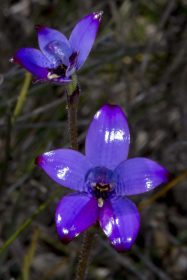
Elythranthera brunonis
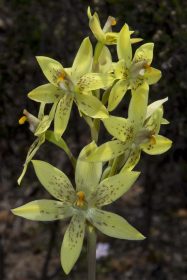
Thelymitra villosa
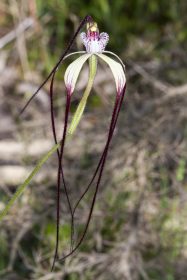
Caladenia chapmanii
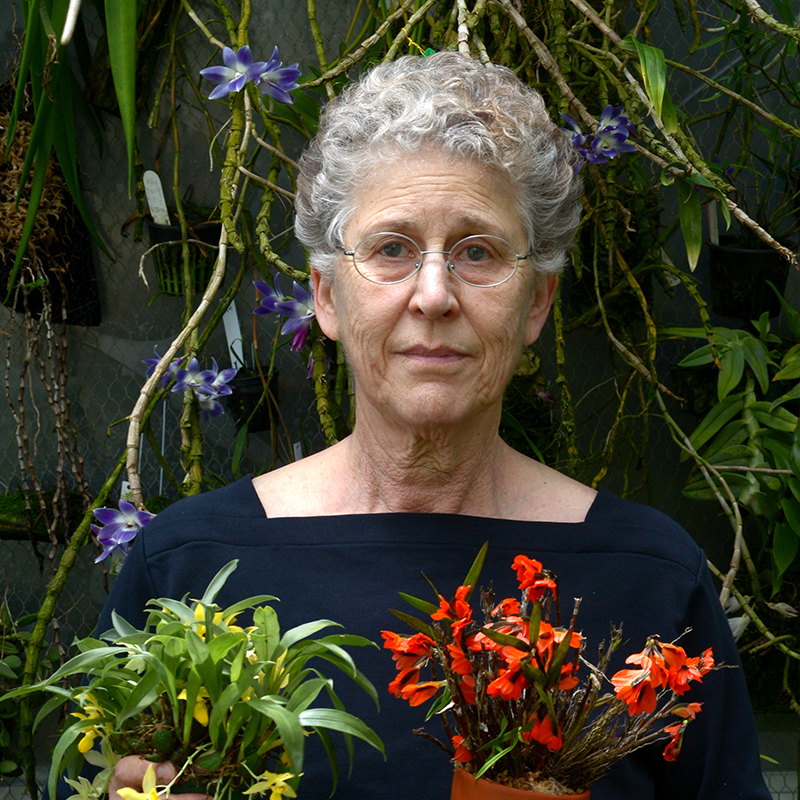 Most of the orchids we see at shows and on show tables are sympodial where one growth finishes and a new one starts from the rhizome. This presentation will focus on those with a monopodial growth habit. Those where the plant grows upward from a single point. It adds leaves to the apex each year and the stem grows longer accordingly.
This talk will focus on the wonderful variety of monopodial genera of great interest to orchid growers. It includes miniatures as well as some rather large species, some well known and others not often seen. It will cover aspects of culture in general and individual species. You will see images of flowers up close as well as whole plants. There should be something of interest to growers from all levels of experience.
Marni Turkel (pronounced tur KELL) is a native of the San Francisco Bay Area and has been growing orchids since 1980. She grows in four greenhouses in Santa Rosa with approximately 1250 sq ft of growing space. Her main interest is in miniature species but plenty of larger plants have crept into the collection as well.
Marni has been a contributor to Orchids magazine with her series called ‘Well Worth the Space’ and ‘Give It a Rest’. Her articles have been translated into Dutch, German, Portuguese and Swedish for international publication. Photographs of her plants have been featured in articles of noted orchid publications including Orchids Magazine, Orchid Digest, Richardiana, The Orchid Review, and The Australian Orchid Review. For the last few years she has been sharing her photographs and knowledge on OrchidsForum.com.
Starting in 2009, Marni expanded her work with orchids to include propagation of orchids from seed and has set up a flasking lab of her own to take the process from start to finish and sell flasks of many of the orchids species in her collection.
After working for over 43 years as a potter, she has retired from ceramics to pursue orchids full-time.
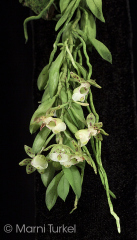
Gastrochilus formosanus
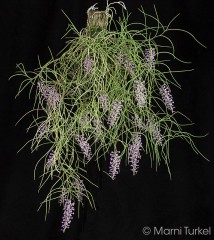
Schoenorchis buddleiflora
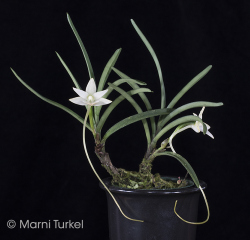
Angraecum lecomtei